Supporting Leaders through guided critical reflection coaching.
Our non-directive critical reflection coaching supports clearer, more rational decision-making. We help people navigate in the demanding world of professional leadership with clarity and confidence.
Find how we can help you become a more effective and confident leader:
Contact us today
The alarming rise of
Imposter syndrome in leadership.
Imposter syndrome is a psychological pattern in which capable, high-achieving individuals doubt their own competence and fear being exposed as a “fraud,” despite objective evidence of success. This can lead to:
- Failour to seak internal support
- Relcutence raise questions or be open to challenge
- Persistent self-doubt about abilities.
- Attributing success to luck rather than skill.
- Fear of being "found out."
- Perfectionism and overworking to compensate for perceived inadequacy.
Aporia Internaltional can help. Our coaches provide a confidential external route to rational reflection. Helping to align confidence to the avialble information and highligting ways to better understanding.
Why Leaders lack deep thinking time.
Leaders work an average of ~62.5 hours per week.
- CEOs spend most of their day interacting with people not engaged in independent thinking.
- Decision-making consumes a substantial portion (~40%) — but it often occurs ad-hoc
- Deep strategic thinking tends to happen in less structured parts of the day between other tasks, resulting in "noisy mind" thinking which is more susceptible to error.
Aporia International reflection session can help by maximising the deep thinking potential of regular dedicated reflection sessions.

Intelligent mistakes
Leaders routinely make high-stakes decisions that are highly susceptible to cognitive biases. This vulnerability is especially acute in leadership roles, where stress, fatigue, and time pressure increase reliance on fast heuristic thinking, raising the risk of systematic and potentially catastrophic errors.
Research consistently shows that highly capable intelligent individuals overestimate their own objectivity and resistance to bias.

The immunity illusion
Knowledge of cognitive bias does not confer any immunity, and intelligent people are no less susceptible to bias than anyone else.
Nobel Prize-winning psychologist Daniel Kahneman, a founder of behavioral economics and a central figure in establishing the empirical study of cognitive bias, wrote:
"I am no better at avoiding these errors than anyone else." — Kahneman, interview discussing Thinking, Fast and Slow (2011)
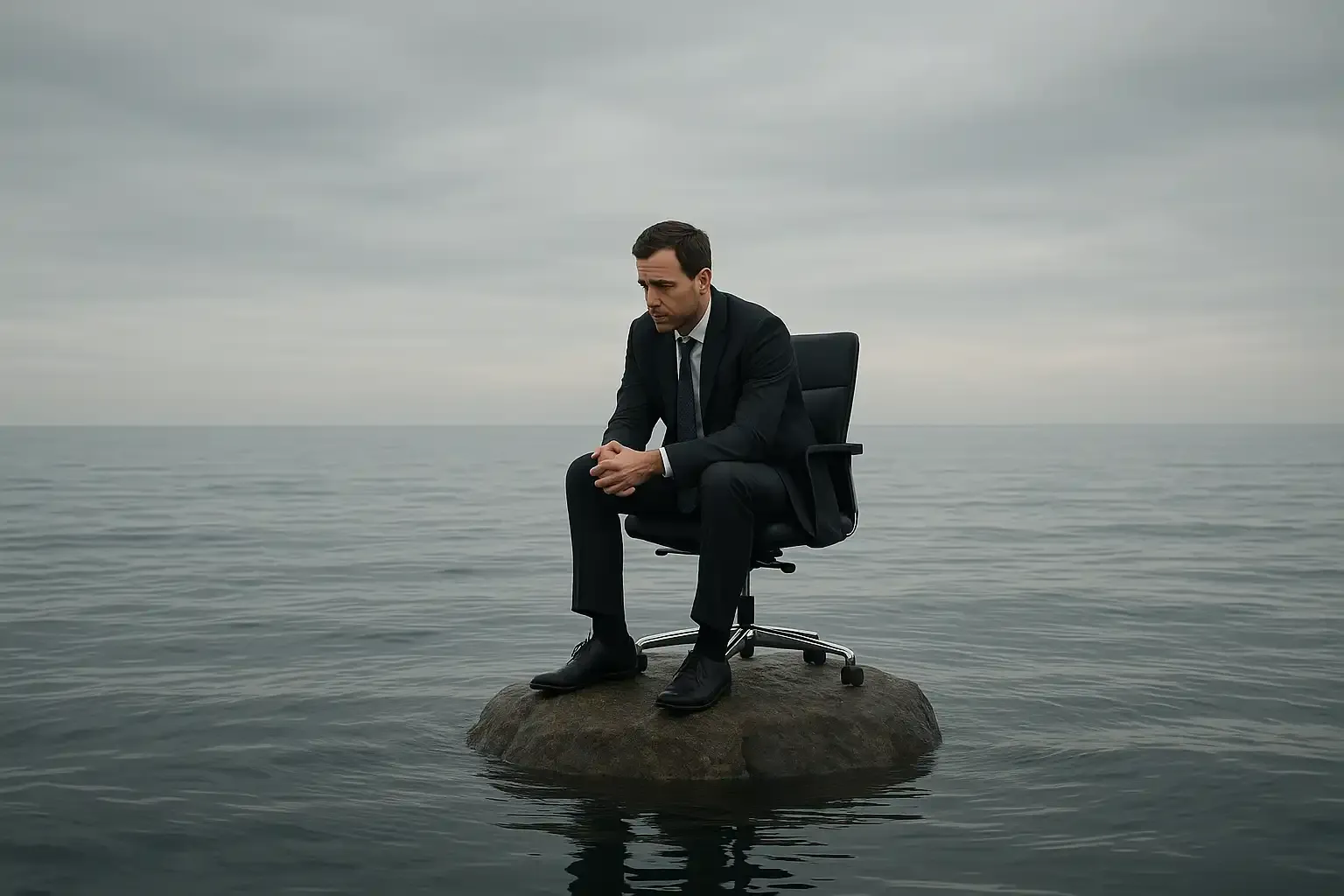
Leadership isolation
Leaders find it difficult to discuss their challenges openly due to concerns about confidentiality, judgment, or perceived weakness.
Subordinates are reluctant to challenge senior staff, defer to authority or want to be seen as team players. Peers fear criticism may lead to risking becoming accountable for outcomes or reputation harm. Everyone has a role in the company but also personal ambition that can conflict with open honest discussion.
This isolation makes it hard to identify and mitigate cognitive biases internally.
Third party advisers and consultants are often engaged in providing particular services. The principal-agent problem means that the interests of most external consultants are frequently misaligned with unbiased reason checking.
Let's talk
For leaders who recognise the risks of unexamined confidence, the next step is a private, confidential diagnostic conversation.
Whether epistemic-reflection coaching is appropriate for your decision environment. This is a low-commitment exploratory session designed to assess
Contact us today